Does your baby sleep safely?
Sudden Unexpected Infant Death (SUID) is the sudden, unexpected and unexplained death of babies under the age of 1. While scientists don’t know exactly what causes SUID, it usually happens in the baby’s sleep area.
Types of SUID include:
- SIDS.
- Accidental suffocation in a sleeping environment.
- Other deaths from unknown causes.
The loss of an infant is tragic, but you can take steps to help prevent SUID.
Sudden Infant Death Syndrome (SIDS) is one type of SUID. In Pierce County, it is one of the top 3 causes of infant death.
Compared to white infants, the ten-year rate is about 28% higher among African Americans and about 15% higher among American Indian/Alaskan Natives. The rate of SIDS among multi-racial infants is about 40% higher than among white infants.
Nationwide, about 3,500 infants die from SIDS each year.
Steps to protect your baby
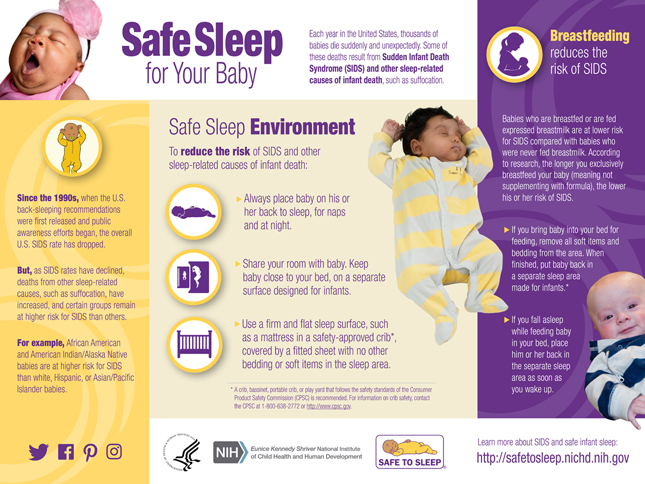
- Room share—When you sleep, have your baby sleep in your room. This is different than bed sharing. Babies still need their own safe sleep surface that follows the ABCs of safe sleep.
- Breastfeed—Breastfeeding your baby reduces the risk of SUID and has many other health benefits.
- Try a pacifier— Offer a pacifier at nap time and bedtime. You shouldn’t force a pacifier. If it falls out during sleep, you don’t need to put it back in.
- Avoid smoking, alcohol, and drug use—When you drink, smoke or use illegal drugs or marijuana during pregnancy (and after birth), you increase the risk of SUID. It hurts your baby when others in your home smoke.
Support for infant loss
People who have experienced this profound loss need the support of close friends and family. The TEARS Foundation’s Center for Child Loss and the Northwest Infant Survival and SIDS Alliance Healing Together program can help. They offer a pregnancy and infant loss support group in Puyallup the 3rd Monday each month from 6:30-8 p.m. If you’re interested, just show up or call (253) 200-0944 with any questions.
Know your ABCs
Alone—Place your baby on a safe, separate sleep surface. Your baby shouldn’t sleep in an adult bed, on a couch or on a chair. They should be completely alone—no siblings, pets or stuffed animals.
Back—Every time you put your baby down to sleep, remember “backside down.” Do not place your baby on their tummy or side.
Crib—A safe crib has a firm, flat surface (a mattress in a safe crib). The mattress should be covered by a fitted sheet and have no other bedding or soft items.
Questions?
Contact us at mchservices@tpchd.org or (253) 649-1404.
More safe sleep resources
- Infant sleep products: What’s safe and what’s not?
- Safe infant sleep updates for 2022: What you need to know to keep your baby safe—Mary Bridge
- Safe Sleep for parents and caregivers—CDC
- Safe to Sleep®—National Institute of Health
- Mary Bridge Center for Childhood Safety
- Northwest Infant Survival and SIDS Alliance
